admin
admin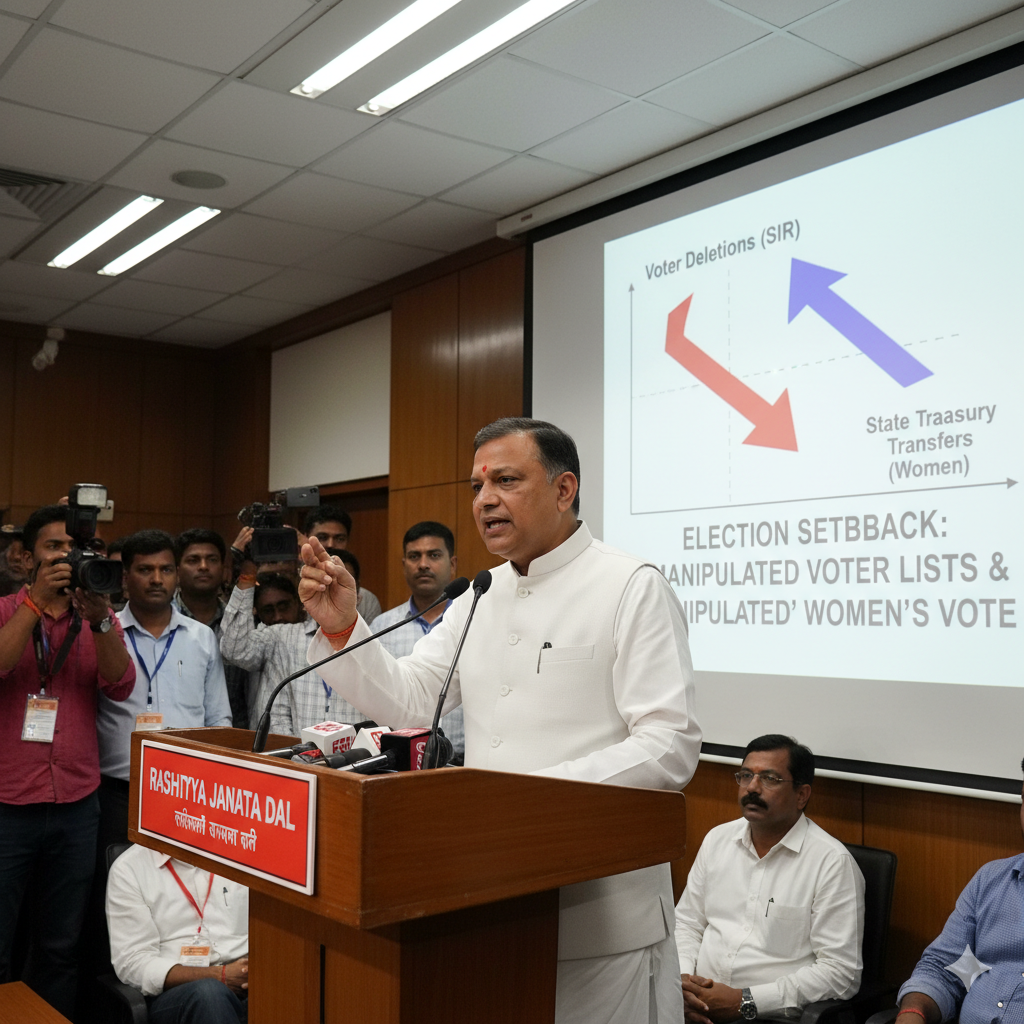
Following a significant electoral defeat, Rashtriya Janata Dal (RJD) Lok Sabha MP and senior strategist Sudhakar Singh has offered a defiant analysis of the party’s performance, expressing strong confidence in a vigorous political rebound. Drawing parallels with the RJD’s resurgence after the 2010 elections, Singh stated the party’s current difficulties are manageable and that the “artificially created vote” of the ruling coalition will soon dissipate.
Citing Voter Rolls and Financial Incentives
Singh attributes the recent setback not to a failure of core ideology but to two specific, powerful maneuvers employed by the incumbent party: systemic voter list manipulation and the use of state treasury funds to sway key demographics.
He claims a “Special Intensive Revision (SIR)” was used to systematically delete impoverished voters, who traditionally support the Opposition, from the rolls. This alleged manipulation, he contends, forced the RJD and the Mahagathbandhan to divert essential campaign resources and energy toward list correction, preventing them from effectively campaigning on the government’s failures.
Singh lent credence to allegations made by the RJD state president, suggesting that the manipulation of voter rolls effectively gave the ruling party a significant advantage—up to 25,000 votes per Electronic Voting Machine (EVM)—before polling even began. He argued that while the ruling alliance achieved this through voter deletions in Bihar, in other states, they focused on additions.
The second major factor, according to Singh, was the strategic use of state money to transfer financial benefits directly to a large voter segment, most notably women. This created a sudden shift in political arithmetic. He warned that this practice of using public funds for electoral gains, which he views as “luring voters,” is irresponsible, will be short-lived, and is destined to trigger a severe economic crisis in the state, diverting focus from critical long-term goals like education and industrialization.
The Decisive Factor: The Women’s Vote
Despite the RJD’s aggressive outreach to Extremely Backward Classes (EBCs), Singh noted that the coalition fell short of its internal projections, securing around 38% of the vote instead of the targeted 43-45%. He pinned this gap squarely on the shift in the women’s vote.
“Men voted for us,” he asserted, “but women shifted towards them because they received government money.” With women voters turning out 8 percentage points higher than men, the ruling side was the primary beneficiary. Singh labeled this use of state funds to influence ballots as “manipulation,” strongly distinguishing it from genuine “women’s empowerment.” He also critiqued the timing of the schemes, which were largely announced just two months before the election after the Chief Minister had been in power for 20 years.
The Law and Order Narrative and Media Bias
Addressing the persistent “Jungle Raj” narrative that has historically plagued the RJD and created a perceived trust deficit among non-Yadav voters, Singh dismissed the issue as being manufactured by a partisan media.
He argued that the law and order situation, often cited as a weakness, was actually inherited, referencing the Naxal movement that began in 1979 and the major communal riots in Bhagalpur in 1989. Singh claimed that it was the RJD’s efficient administration that effectively neutralized Maoism by 2000 and controlled communal riots by 1996, a record he feels is obscured by a media “ideologically committed to the BJP–RSS.”
In closing, the RJD strategist defended the party’s heavy focus on “vote theft” during the campaign, asserting that their primary role is not merely to seek power but to act as “protectors of the Constitution and democracy.” He concluded by confirming the party’s intent to spend the next two years educating voters on the alleged misdeeds of the current administration.