admin
admin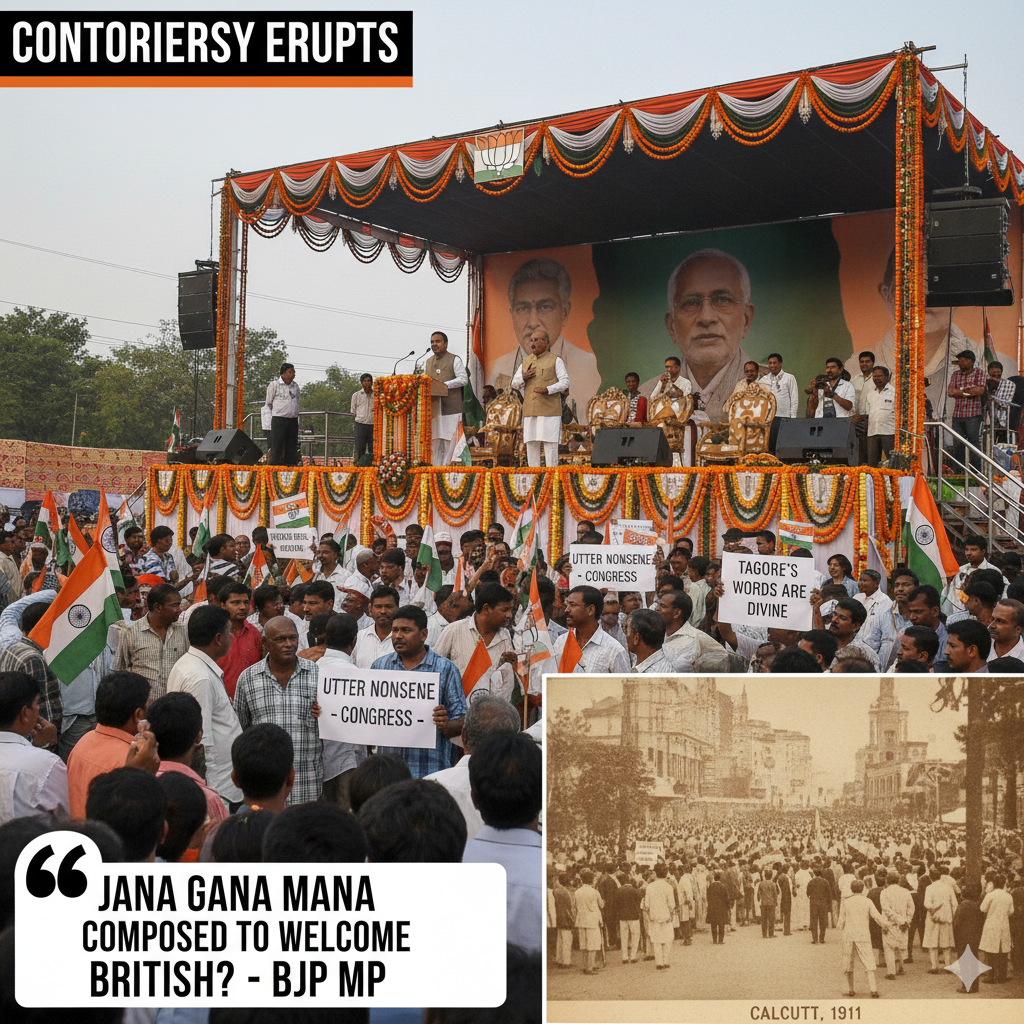
A significant political row has ignited following remarks made by Bharatiya Janata Party (BJP) MP Vishweshwar Hegde Kageri, who asserted that India’s National Anthem, “Jana Gana Mana,” was originally composed as a welcome song for the British.
The controversy began when Mr. Kageri, while speaking at a public forum, commented on the historical choice of the anthem. He reportedly stated that while proponents of “Vande Mataram” had strong arguments, Indian leaders ultimately accepted “Jana Gana Mana,” which he claimed was “composed to welcome the British.”
The statement drew immediate and sharp criticism from opposition leaders. Karnataka Congress leader Priyank Kharge slammed the MP’s assertion, dismissing it as “utter nonsense” and a mere “WhatsApp history lesson.” Kharge took to social media to clarify the historical record and rebuke the claim.
The Historical Context and Rebuttal
Historically, the debate over “Jana Gana Mana’s” origin stems from its first public performance. The song, which is the first stanza of Rabindranath Tagore’s five-stanza composition Bharoto Bhagyo Bidhata, was sung on December 28, 1911, at the annual session of the Indian National Congress in Calcutta.
The confusion arose because this Congress session also included a separate resolution expressing loyalty to King George V, who was visiting India at the time, and a separate song was sung in his honor. Certain Anglo-Indian newspapers subsequently published inaccurate reports, mistakenly linking Tagore’s composition to the felicitation of the British monarch.
Tagore himself addressed this persistent controversy several times during his lifetime. In letters written in 1937 and 1939, the Nobel laureate emphatically clarified that the song praises the “Dispenser of India’s destiny” (Bharata Bhagya Vidhata), which he confirmed was a reference to the divine, the eternal guide, and not to King George V or any other earthly monarch. He stated that he would insult himself if he were capable of such “unbounded stupidity” as to sing in praise of a king as the “Eternal Charioteer.”
Despite the historical refutations, the debate over the anthem’s meaning occasionally resurfaces in political discourse, as seen with Mr. Kageri’s recent remarks.