admin
admin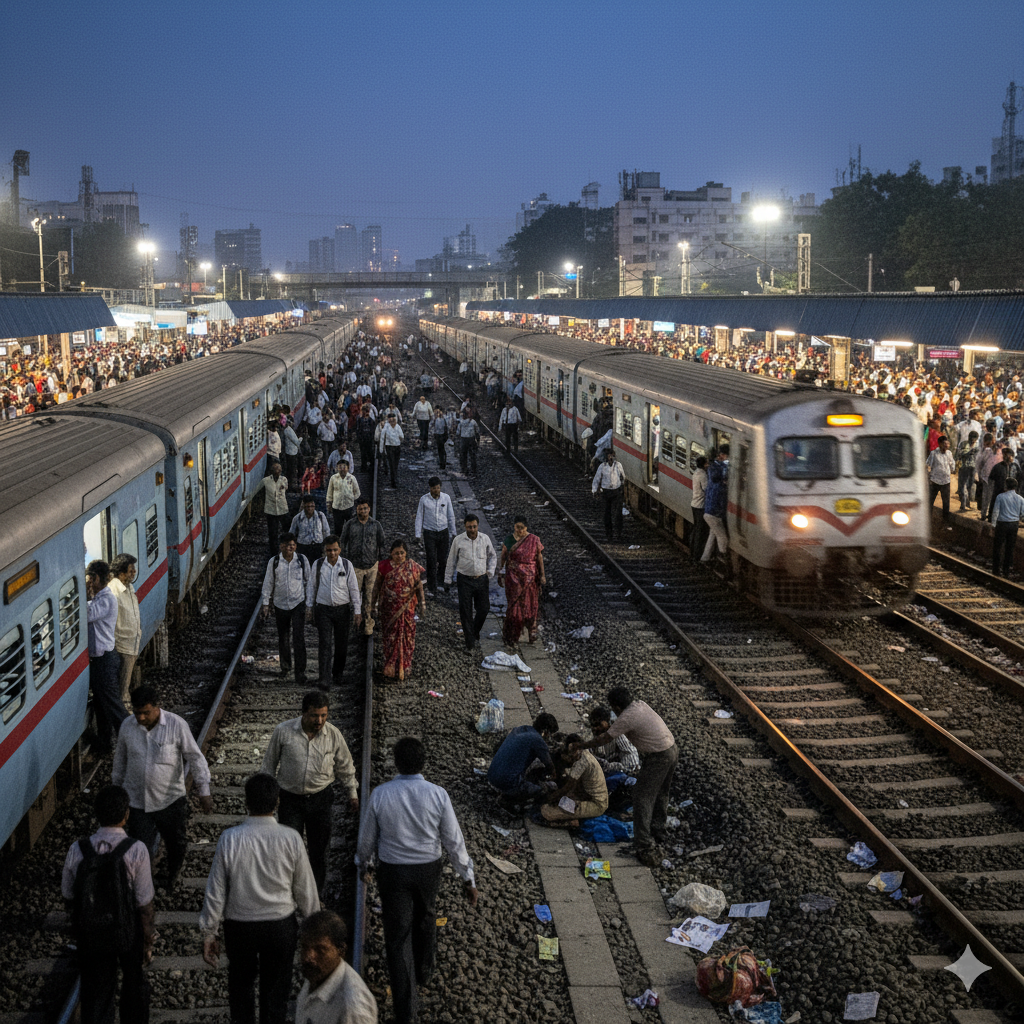
MUMBAI: A dangerous combination of extreme rush-hour overcrowding and a sudden labor protest brought the Central Railway (CR) suburban network in Mumbai to a standstill last Thursday, leading to a tragic accident that claimed the lives of two commuters.
The critical incident unfolded at and around the Chhatrapati Shivaji Maharaj Terminus (CSMT), plunging one of the world’s busiest commuter systems into chaos. Platforms were severely jammed as thousands of office workers attempted to return home.
Protest Triggers Paralysis
The immediate cause of the operational collapse was a flash protest staged by the Central Railway Mazdoor Sangh (CRMS). Employees gathered near the motormen’s lobby, successfully preventing train crew from accessing their posts and halting suburban train services for approximately one hour.
The union’s action was a response to legal proceedings initiated against two CR engineers. An FIR had been filed against the officials concerning a separate, prior accident near Mumbra station on June 9, which resulted in five deaths.
Fatal Decision on the Tracks
With trains immobilized on the lines and major stations like Thane and Masjid Bunder dangerously overcrowded, stranded commuters grew desperate. Many passengers made the risky decision to disembark from the halted carriages and walk along the active railway tracks in an attempt to continue their journey on foot.
This peril turned fatal at around 6:50 p.m. near Sandhurst Road station. A passing local train struck a group of five commuters who were walking on the main line. Two people—identified as 19-year-old Hailey Momaiya and 45-year-old Suryakant Nayak—were killed, and three others sustained injuries.
Underlying Dispute
The day’s events highlighted the deep tensions surrounding the earlier June 9 Mumbra mishap. The Government Railway Police (GRP) had assigned blame to the railway’s engineering division, alleging criminal negligence for ignoring multiple warnings about track instability. The GRP’s case is supported by a technical report from the Veermata Jijabai Technological Institute (VJTI).
Conversely, the railway administration has publicly rejected the GRP’s findings, labeling them “technically flawed.” In the aftermath of the recent disruption, the two engineers who were booked have filed an application for anticipatory bail.
The cumulative crisis led to the cancellation or delay of approximately 30 train services, severely impacting daily life for thousands of Mumbai residents who rely on the city’s rail lifeline.