admin
admin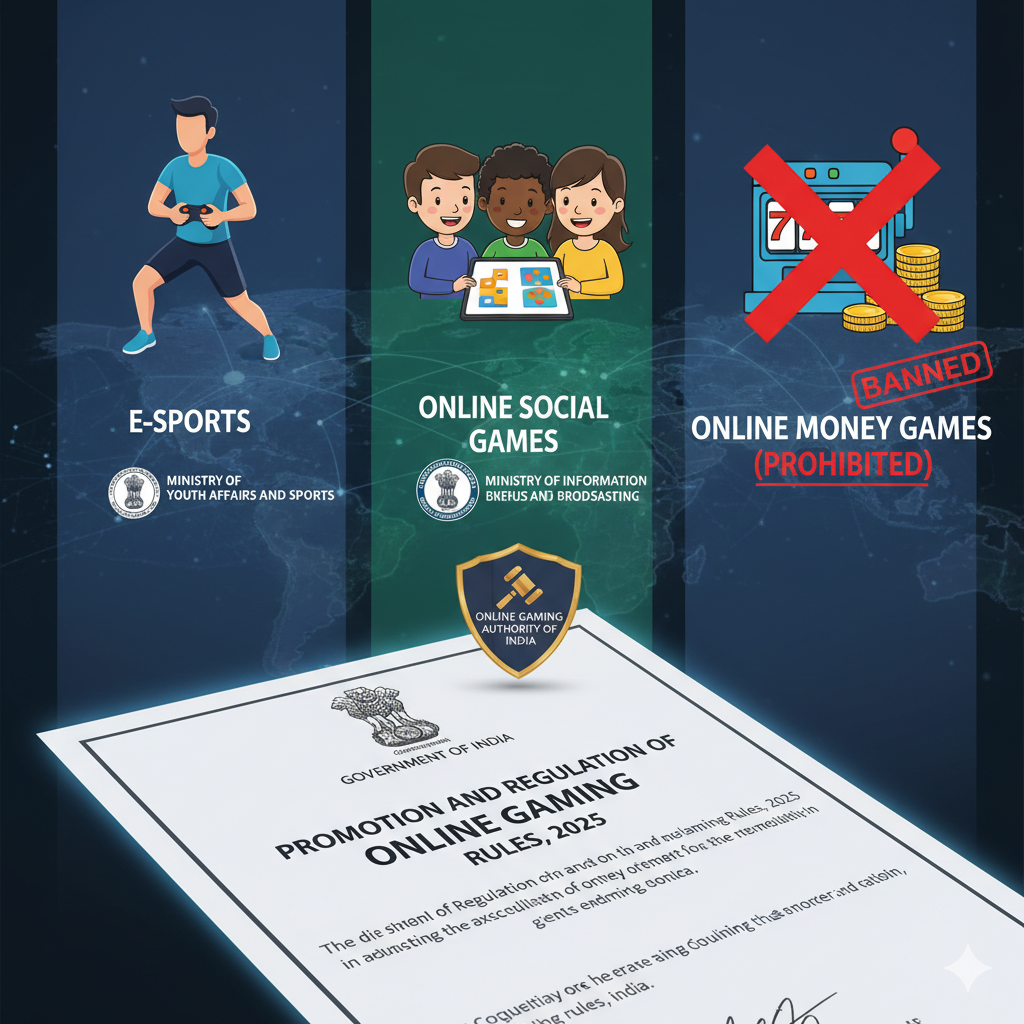
The Government of India, through the Ministry of Electronics and Information Technology (MeitY), has released the draft Promotion and Regulation of Online Gaming Rules, 2025, pursuant to the Promotion and Regulation of Online Gaming Act, 2025 (PROG Act). The primary goal of these rules is to establish a clear, national framework that fosters the growth of legitimate e-sports and social gaming while aggressively regulating and prohibiting exploitative online money games.
Key Provisions of the Draft Rules
The draft rules establish the procedural framework for operationalizing the Act, with the following core components:
1. The Online Gaming Authority of India
A new regulatory body, the Online Gaming Authority of India, is established as a corporate body with powers similar to a civil court. Its functions include:
- Determining whether a specific game qualifies as a prohibited “online money game.”
- Managing the recognition, categorization, and registration of legitimate online games.
- Investigating complaints and imposing penalties for non-compliance.
2. Game Categorization and Promotion
The framework divides online games into distinct categories, with different ministries overseeing their promotion:
- E-sports: Recognized as competitive, skill-based digital sports, their development is overseen by the Ministry of Youth Affairs and Sports.
- Online Social Games: These are recreational or educational games that do not involve wagering. They are promoted by the Ministry of Information and Broadcasting. Significantly, these games may be offered without mandatory registration, provided they do not involve stakes.
- Online Money Games (Prohibited): Games where users deposit money or stakes with the expectation of winning monetary rewards are strictly prohibited.
3. Registration and Compliance
Online gaming service providers can apply for a Certificate of Registration with the Authority, typically valid for up to five years. Key compliance requirements include:
- Mandatory Disclosure: Applicants must provide details on their business registration, game description, intended age group, revenue model (excluding wagers), and user safety/grievance mechanisms.
- Material Change Notification: Service providers must inform the Authority of any “material change” to the game, particularly any modification to the features or revenue model that could potentially shift its classification toward becoming a prohibited online money game.
4. Penalties and Enforcement
The Authority is empowered to impose strict measures for non-compliance, especially concerning prohibited money games:
- Banning: If a game is determined to be an “online money game,” the Authority will order it to cease operations and can add it to a public list of banned games.
- Punishment: The Act outlines severe penalties for offering or facilitating online money games, which can include imprisonment of up to three years and large fines (up to ₹1 crore). Financial institutions are also prohibited from processing transactions for banned platforms.
Public Feedback
The government had invited feedback and suggestions from stakeholders and the general public on the draft rules to ensure a consultative and comprehensive regulatory process before the rules are finalized and implemented.