admin
admin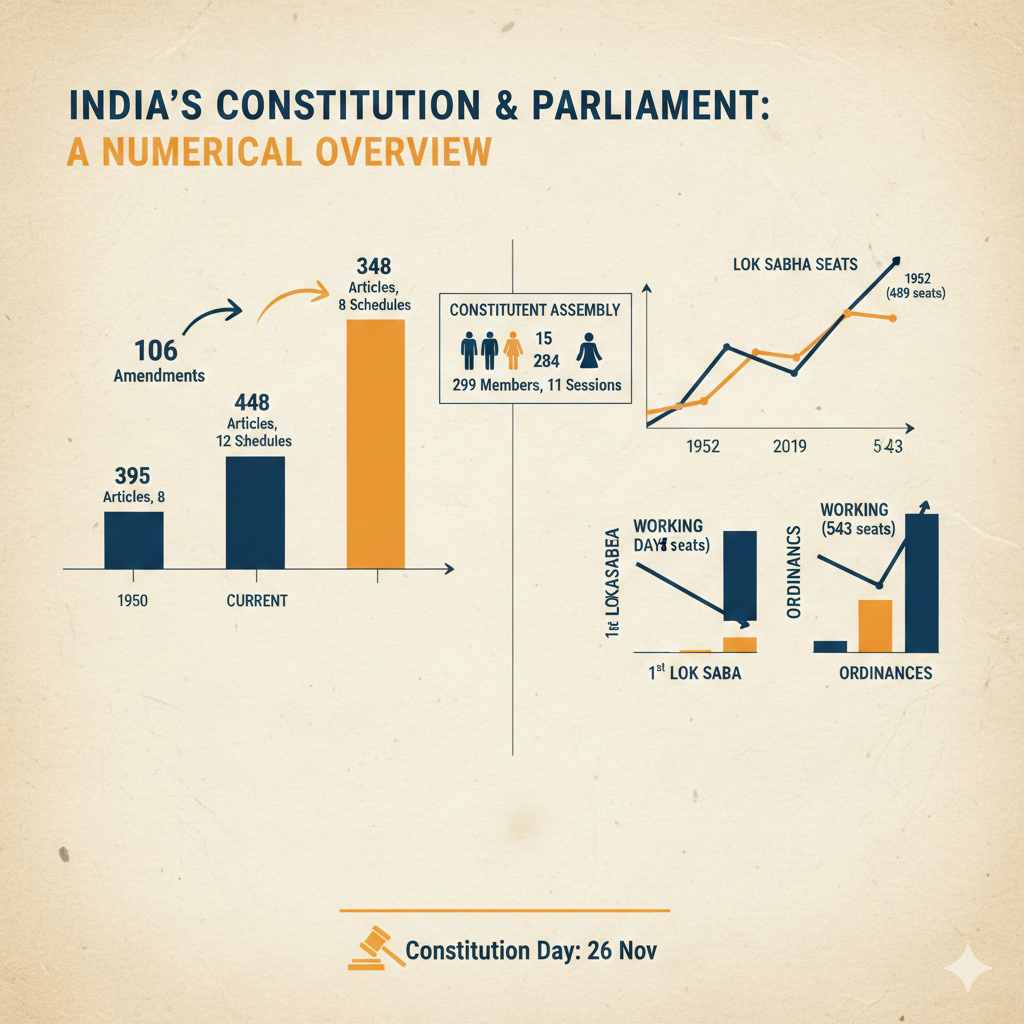
India’s Constitution, often referred to as a “living document,” was adopted by the Constituent Assembly on November 26, 1949, and officially came into force on January 26, 1950. Since 2015, the date of adoption has been celebrated as Constitution Day. A review of key figures illustrates the Constitution’s creation, transformation, and its effect on the nation’s legislative body.
1. The Constitution in Numbers
The journey from draft to the current form shows a significant expansion of the founding text:
2. The Constituent Assembly (1946–1949)
The body responsible for drafting the Constitution comprised a total of 299 members during its final sessions, which took place over 11 sessions and 166 sitting days.
3. Constitutional Amendments
In total, the Constitution has been amended 106 times.
- The decade of the 1970s saw the most amendments, largely occurring during Indira Gandhi’s administration leading up to the Emergency.
- The maximum number of amendments in a single year was 6, passed in 1990 under the V.P. Singh government.
4. Evolution of Parliament
The strength and nature of the Lok Sabha (Lower House of Parliament) have changed over time:
- The number of seats in the Lok Sabha increased periodically through delimitation exercises as the population grew.
- As a result, each Member of Parliament (MP) now represents an increasingly populous constituency.
- In 2019, the strength of the Lok Sabha was set at 543 following the abolition of the nominated seats reserved for the Anglo-Indian community.
- While women’s representation has improved, it remains low compared to their overall share in the national population.
5. Parliamentary Functioning
Trends in parliamentary activity show a decrease in legislative time and increased reliance on executive action:
- Parliament has been recording fewer annual working days and hours.
- This has correlated with a decrease in the number of Bills passed and a greater reliance on promulgating laws via Ordinances.
- Historically, the First Lok Sabha had the highest average number of annual sitting days, while the Fifth Lok Sabha was the most productive in terms of Bills enacted.