admin
admin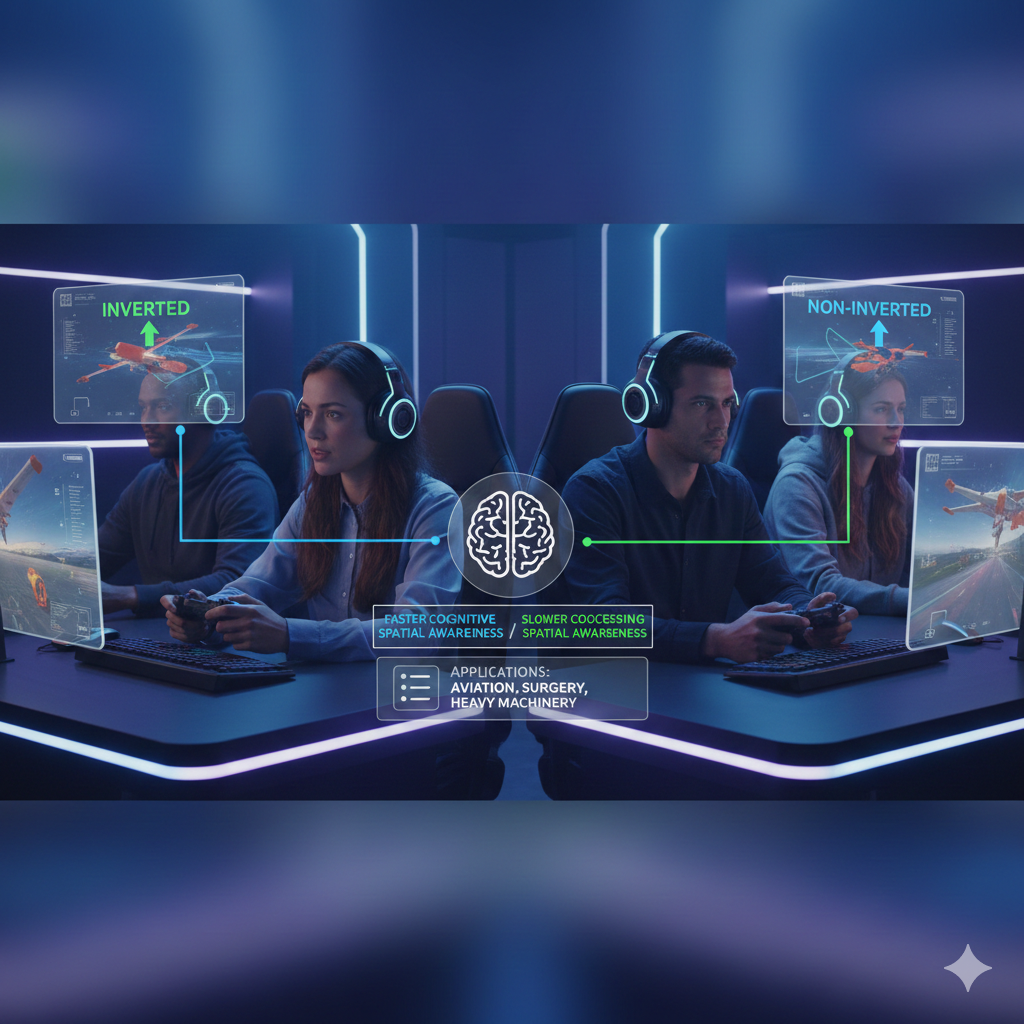
For decades, gamers have been divided over a simple question: should you pull back on the joystick to look up, or push forward? This setting, known as inverted controls (like the yoke of an aircraft where pulling back raises the nose), has often been attributed to personal preference or early exposure to flight simulation games.
However, recent cognitive research suggests that the choice between inverted and non-inverted controls is not merely a matter of habit or quirk, but a fascinating manifestation of spatial cognition—how the brain processes and interacts with three-dimensional space.
Spatial Perception is the Key
A study by researchers including Dr. Jennifer Corbett and Dr. Jaap Munneke challenged the long-held assumption that control inversion is simply learned behavior. Through a combination of large-scale surveys, detailed behavioral tests, and machine learning analysis, they discovered that the preference is deeply rooted in an individual’s cognitive processing speed and spatial perception.
The key finding centered on how quickly players process information related to spatial relationships. The research indicated a strong correlation:
- Non-Inverted Preference: Players who demonstrated faster cognitive processing of spatial information tended to stick with the default non-inverted controls (push forward to look up).
- Inverted Preference: Players who were slower at spatial processing tended to gravitate toward the inverted setup (pull back to look up).
This finding suggests that the control scheme a person prefers is tied to a specific aspect of brain function rather than their skill level or accumulated gaming experience. The inversion setting appears to better match the way certain brains naturally map their actions to movement in a virtual 3D environment.
Overturning the “Habit” Theory
While early exposure to certain types of games (like flight simulators) certainly plays a role in forming the initial preference, the study highlights that the underlying predisposition is cognitive. A player may feel they are “naturally” an inverter, but the science suggests this feeling stems from a compatibility between their unique spatial processing patterns and the control scheme.
The research reframes the debate: it’s not about which method is objectively better; it’s about optimizing the human-machine interface to align with an individual’s cognitive strengths.
Broader Implications Beyond Gaming
Understanding this link between cognitive processing and control preference has implications far beyond video games. Any field that relies on precise, rapid human-machine interaction could benefit:
- Aviation: Optimizing cockpit controls for pilots.
- Surgery: Tailoring controls for robotic surgical equipment.
- Heavy Machinery: Designing intuitive controls for operators.
By matching control setups to an individual’s natural spatial perception and cognitive patterns, tasks requiring precision and quick decision-making could be made safer and more efficient.
Furthermore, the study suggests that challenging the brain by deliberately experimenting with the opposite control scheme might actually help enhance a person’s spatial awareness, reaction times, and overall adaptability, offering a cognitive benefit that extends outside of the gaming session.