admin
admin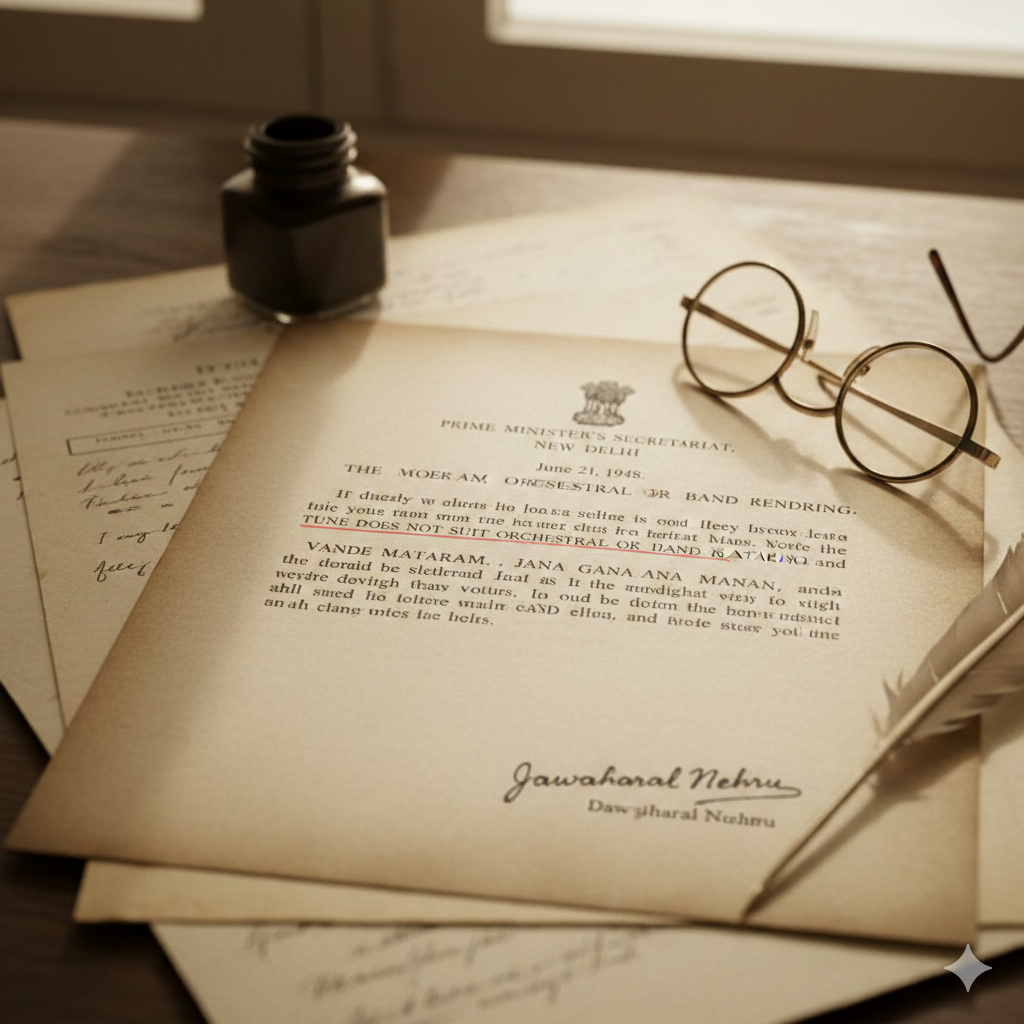
Recently digitized documents from the Nehru Memorial Museum and Library (NMML), now known as the Prime Ministers’ Museum and Library (PMML) archives, shed light on the considerations that led to the selection of ‘Jana Gana Mana’ over ‘Vande Mataram’ as India’s National Anthem.
The records confirm that the decision was not based on the emotional or historical significance of the songs, but primarily on technical and musical grounds.
The Orchestral Suitability Constraint
A pivotal document is a letter dated June 21, 1948, written by then-Prime Minister Jawaharlal Nehru to Syama Prasad Mookerjee, a minister in his cabinet. Nehru explained that the Cabinet’s provisional decision to favor ‘Jana Gana Mana’ was driven by practical necessity, particularly its suitability for formal occasions.
Nehru stated that the main reason ‘Vande Mataram’ was not feasible as a national anthem was “chiefly because of its tune which does not suit orchestral or band rendering.” Immediately following independence, the government urgently needed a distinctive tune to be played by the Defence Services and at embassies abroad, replacing ‘God Save The King.’
Preference for ‘Jana Gana Mana’
In contrast, ‘Jana Gana Mana’ was deemed superior for these formal, international purposes. Nehru noted that the music of Rabindranath Tagore’s composition was already:
- Internationally Appreciated: It had been widely praised when an orchestral version was played at the United Nations General Assembly in 1947.
- Technically Adaptable: The tune lent itself easily to orchestral and band arrangements, a key requirement for a national anthem.
- Symbolic of Achievement: Nehru also offered a philosophical distinction, suggesting that a song representing a “poignant longing for freedom” (Vande Mataram) was less fitting than one that embodied the “element of triumph and fulfillment” (Jana Gana Mana) after independence had been achieved.
Status as the National Song
The documents make it clear that the government did not intend to diminish the importance of Vande Mataram. Nehru affirmed its standing as the premier national song, acknowledging its deep emotional connection to the entire freedom struggle.
Ultimately, the Cabinet recommended that ‘Jana Gana Mana’ be used as the official anthem until the Constituent Assembly made a final decision, a choice that was later ratified, with ‘Vande Mataram’ retaining the status of the National Song.