admin
admin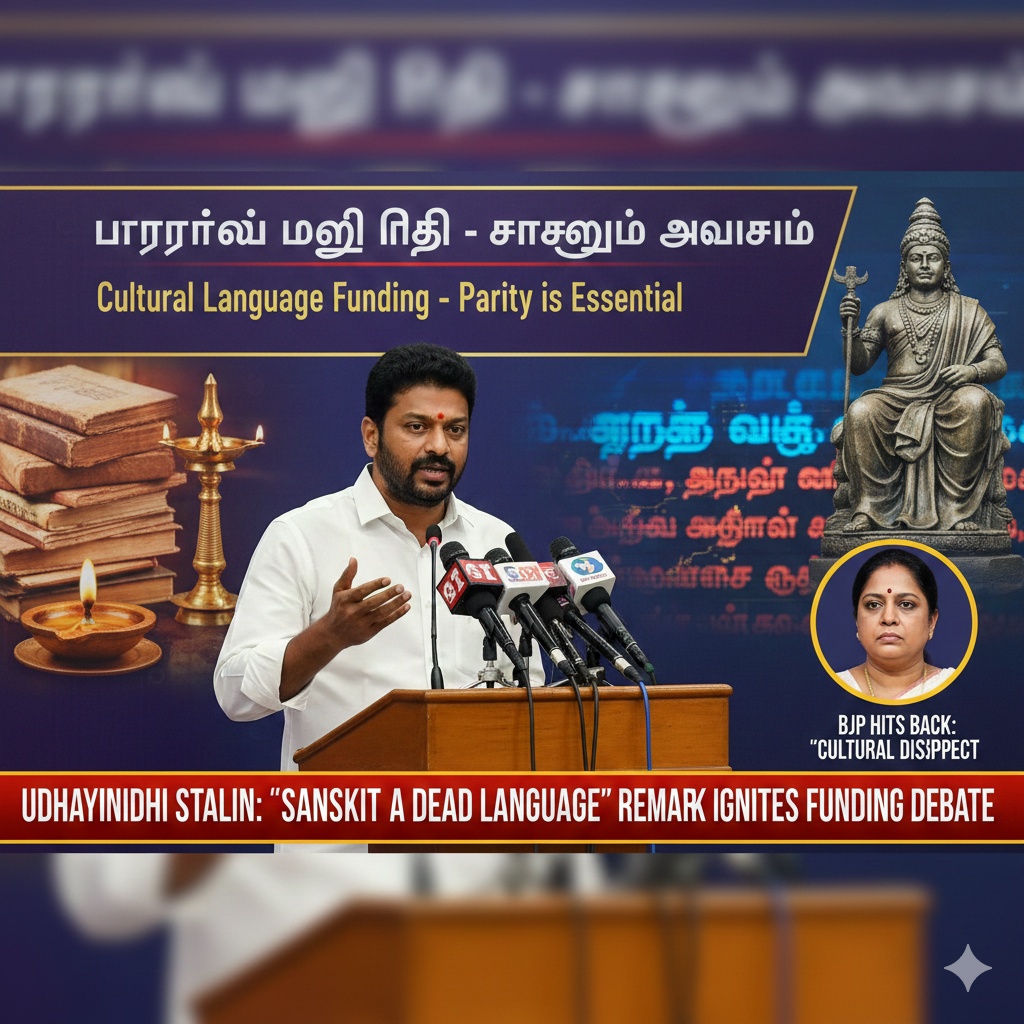
Tamil Nadu Deputy Chief Minister Udhayanidhi Stalin ignited a political firestorm recently when he referred to Sanskrit as a “dead language,” a comment that quickly escalated beyond mere rhetoric into a serious debate over the Union government’s financial priorities for classical languages.
Speaking at a book launch event in Chennai, Stalin’s phrasing was aimed at underscoring what he and his party, the Dravida Munnetra Kazhagam (DMK), view as a stark budgetary imbalance. He asserted that while a substantial sum of Rs 2,400 crore was reportedly allocated for Sanskrit promotion, development efforts for the Tamil language received only Rs 150 crore.
This criticism is not new for the Tamil Nadu leadership. Both Chief Minister M.K. Stalin and Finance Minister Thangam Thennarasu have previously questioned the central government’s language policies and funding decisions, arguing that the vast disparity in resource allocation structurally disadvantages ancient languages like Tamil. The concern raised by the DMK is not an objection to Sanskrit receiving support, but rather that other languages are inadequately funded at the national level. They argue the fight is for “parity” in cultural support, not superiority.
The Bharatiya Janata Party (BJP) immediately pushed back against the statement, accusing Stalin of cultural disrespect. Former state BJP president Tamilisai Soundararajan condemned the remark, insisting that no one has the right to label any language as dead, especially one that remains central to religious prayers and rituals across India. She cautioned against a political strategy that seeks to elevate one language by belittling another.
Furthermore, official records support the claim of a significant funding gap. According to a reply provided to the Lok Sabha in December 2022, the Central Sanskrit University in New Delhi received approximately Rs 1,487.84 crore in grants between 2014-15 and 2021-22 for the advancement of Sanskrit, along with Pali and Prakrit. In sharp contrast, the Central Institute of Classical Tamil (CICT) in Chennai received only Rs 74.1 crore during the same period. This structural asymmetry has historically required Tamil’s growth and survival to rely heavily on state policy and diaspora support rather than sustained central institutional backing.
While many scholars contest the term “dead language,” given Sanskrit’s immense academic value in fields like philosophy, linguistics, and mathematics, they concede that the financial discrepancy highlighted by the Deputy CM is factual. Experts who weighed in on the controversy noted that while the manner in which Stalin articulated his grievance may have provoked unnecessary antagonism, the core issue is a documented financial disparity. They concluded that the central government’s policy choices are the root of the problem, rather than the intrinsic value of Sanskrit itself.